The Essential Beginner Toolbox
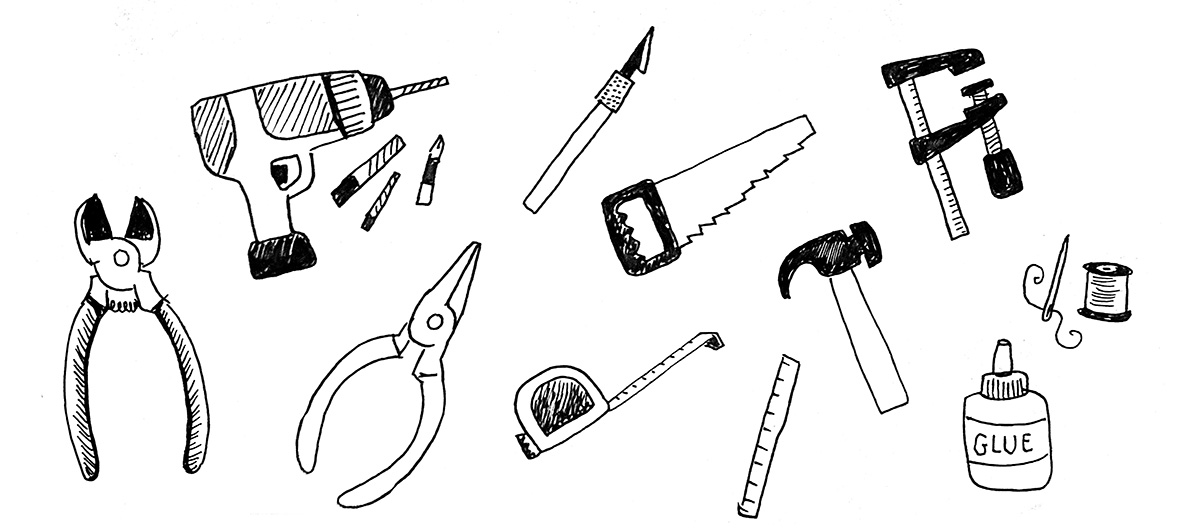
Building and repairing your own things is one of the most rewarding skills you can learn. Sometimes its as simple as fixing a crack in your favorite bowl, sometimes its as complicated as building a custom shelf for a strangely shaped corner. Either way, being able to do it yourself will make you more self-sufficient and confident, and give you a new sense of ownership over your belongings and your spaces. It all starts in one place: Your toolbox.
Making a toolbox can be overwhelming when you’re just starting out. There are a LOT of options out there, and its hard to know what you need and what you don’t. There are certainly pre-designed starter toolboxes you can buy, but they won’t necessarily have all of the essential things for the kind of thrifty DIY'ing that I find most useful. This is a breakdown of the essential tools with the most bang for your buck — and janky alternatives that can successfully replace them.
I won’t include anything expensive, anything hard to find, and only one cheap power tool (which of course, can be substituted for the non-powered version). I also won’t include links to purchase these tools online because I always believe in buying local when possible — so I HAVE included the type of store to find each one at! Do your best, but there’s no shame in hitting up Am*zon if that’s the only thing available to you. :)
I’ll break it down into four categories of Things Tools Do: Cut, Hold, Impact, and Measure. With these four abilities, you’ll be able to make or fix just about anything you put your mind to!
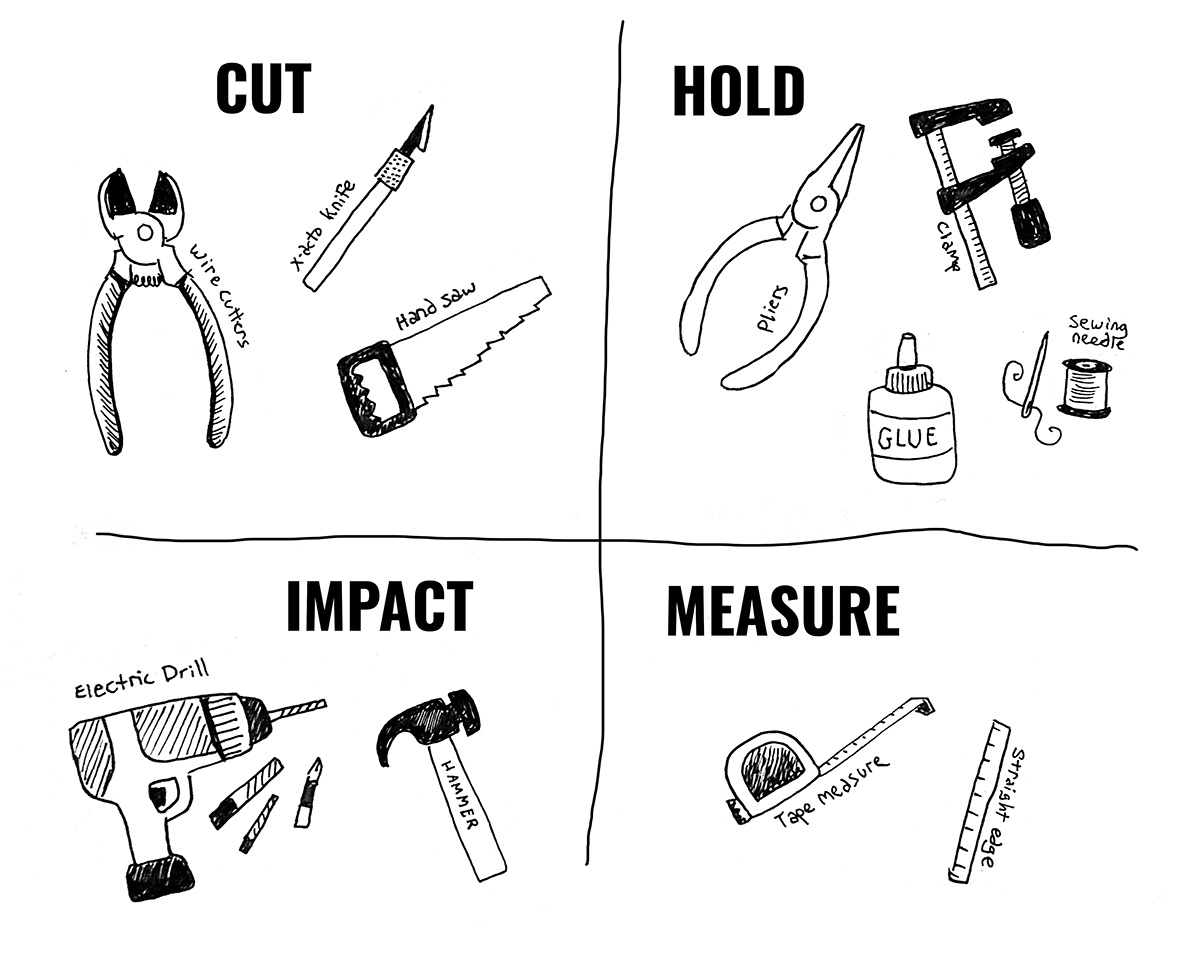
CUT
- Wire Cutters for clipping things that might dull your scissors Substitute: scissors
Average Price: $5 - X-acto Blade for small precise cuts
Substitute: small kitchen knife
Average Price: $3 - Hand saw for big cuts
Substitute: honestly, borrow someone else’s saw
Average Price: $8
HOLD
- Pliers for holding small things with precision
Substitute: fingers
Average Price: $5 - Two small clamps for holding things over a long period of time
Substitute: a pile of books or heavy object on a flat surface
Average Price: $10 each - Screws for holding firm things together permanently
Substitute: nails, sometimes
Average Price: $5 for a small kit - Sewing needle and thread for holding soft things together permanently
Substitute: staples will do in a pinch
Average Price: $8 - Glue for holding anything together permanently
Substitute: glue gun, mod podge, or tape might work in a pinch
Average Price: $5
IMPACT
- Power Drill for making holes in things and putting screws in things
Substitute: screwdriver with self-drilling screws
Average Price: $25 - Hammer for pounding things into place
Substitute: place a flat, sturdy surface (like a spare piece of wood or a cutting board) over your target, and hit it with something that won’t break.
Average Price: $5
MEASURE
- Tape Measure for knowing the length of things
Substitute: an object you know the length of
Average Price: $6 - Straight Edge for drawing or finding straight lines
Substitute: the edge of a book, and envelope, a laptop, a table, etc etc.
Average Price: $2
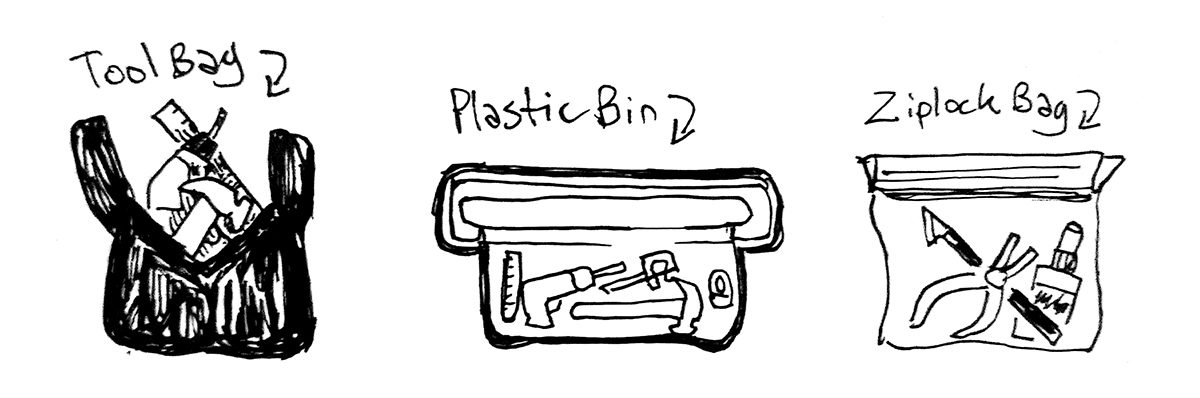
And there you have it! This relatively small set will get you through almost any project. If you don’t have a toolbox, you can use a plastic bin or even a tote bag to store them in (except for the saw) and a pencil case or ziplock bag will help keep your small items together.
Personally, I use a soft tool bag (pictured below) that my drill came with, and then two smaller tool bags, one I snagged from my dad, and the other I purchased.
The details!
Here is some more info on each type of tool, some tips on using it and its alternatives, and where to find it. Feel free to send me a message with any questions beyond this!
Wire Cutters
Why: Wire cutters can cut most materials, and won’t get dull like scissors will. Wire is also a really useful material to work with! You can use it to attach things together, make an improvised hook, fix jewelry, and lots of other things. Where: You can get them at a hardware store or craft store.
Xacto Blade
Why: For cutting small things or making accurate cuts. The blades can easily be replaced and are pretty cheap for a pack of 50, so you won’t have to worry about it getting dull. I carry one in my pencil case at all times.
Where: A craft store is your best bet.
Handsaw
Why: When you’re working with wood or even foam-core boards, a saw is the only way to go. A simple handsaw isn’t particularly fun to use, but it’ll get you far.
Where: Hardware store.
Pliers
Why: They’re great for small, accurate work. You should get both the flat-nose and the needle-nose for jewelry or wire work, but flat-nose pliers alone will be good for anything else.
Where: Craft store for the needle-nose and small flat-nose, hardware store for a heftier flat-nose.
Small Clamps
Why: If you’re gluing something together, clamps are the best way to go to ensure a tight fit. Two small clamps will take care of most situations for you. Don’t worry about price, the cheapest ones will hold just as well as the expensive ones.
Where: Hardware store.
Screws
Why: Screws can do it all. Or, most. In any case, I love them. Hang a picture, attach two pieces of wood together, use them as makeshift hooks, etc etc!
Why not nails: If a nail can do it, 99% of the time a screw can do it too. But the reverse is not always true! Screws tend to make a bigger hole than a nail, but they are sturdier, more versitile, and much easier to remove.
If you have a drill: Any screws will do, because you can drill a pilot hole!
If you don’t have a drill: Make sure to buy very pointy, or self-drilling screws.
Where: Hardware store.
Sewing Needle
Why: Whether its fixing a rip in a shirt or making yourself a home-made heat pack, any work with fabric should have a sewing needle on hand.
Where: The craft store or fabric store. You can also find travel kits at gas stations, rest stops, and airports.
Glue
Why: Stick stuff together!!! I’d recommend having two types: a general use glue (my favorite is Gorilla Glue) and a Super Glue. General use can be used for most things, but super glue is uniquely essential for fixing broken dishes or reinforcing buttons on clothing. If you have really heavy-duty stuff to glue together, look for epoxy glue.
Where: Hardware store, craft store, or office supply store
Power Drill
Why: Why electric? I held off getting an electric one for ages, and even tried to find a hand-crank drill because I didn’t feel like I really needed it. (It turns out a hand-crank drill is really hard to find.) However, it will REALLY open up doors for you. Putting screws into place is much easier, but also DRILLING HOLES INTO THINGS. Wow. Seriously.
(As a note, if you don’t have one and just use a screwdriver, look for “self-drilling” screws. This means that you don’t have to drill a starter hole to get the screw in.)
Where: Hardware store.
Hammer
Why: Nothing beats a hammer when it comes to hitting things. You can also use a board and hard-thing to hammer in nails. The method involves putting a board flat against the end of (usually) a nail, so the force of the blow distributes evenly across the board. As long as the board is perpendicular to the nail, all the force will go in the correct direction. Its a necessary precaution, because your object most likely doesn’t have the flat hitting surface that a hammer has. It’ll do in a pinch, but its difficult. Any kind of hammer will make a big difference, even a small cheap one.
Where: Hardware store or office supply store
Tape Measure
Why: Whether you’re building something or buying furniture or fitting clothing to yourself, a tape measure will do you well. However, there are good methods for measuring things without one! The first is using an object you know the length of, for instance, a common moleskine notebook is 8" the long way. Divide the edge in half, then half again, and then half once more, and you’ve got an accurate ruler. If you don’t need actual numbers or are measuring something long, use a piece of string and tie a knot or mark it with a pen to record your measurement. If you need the numbers, use the first technique to make a homemade ruler, and run your string along it, a bit at a time, to find the length.
Where: Hardware store.
Straight Edge
Why: Straight lines are important! There are all sorts of reasons you might want to draw or identify a straight line. A ruler is the standard, but the number of objects you can use to achieve this is pretty much anything with a straight edge on it.
Where: Pretty much anywhere! Nice!
I hope this guide gave you some helpful info! Go ahead and shoot me an email if you have questions, I’d love to hear from you. :)